Showing posts with label sand dunes. Show all posts

Tuesday, April 2, 2013

Sidewinder races? Really?


I hope you enjoyed my April Fool's Day story! (Some of you may remember it from last year.) It sounds like a few people fell for it, others were amused by it, and some wanted to know how much "truth" the story contained. So, just for the record ...

Panamint Springs Resort, the Death Valley Natural History Association, Furnace Creek Resort, and the Timbisha Shoshone Tribe are all real organizations. I hope they don't object to my using their names. Bakersfield is a real place, too, or so I've heard.

All of the historical figures I mentioned are real people. Death Valley Scotty was a well-known con man who I like to imagine would have staged a sidewinder race if he had thought of it. Albert Johnson was a Chicago millionaire who continued to fund Scotty's extravagant lifestyle long after realizing he'd been conned. His vacation home in Grapevine Canyon, which he called Death Valley Ranch, is now known as Scotty's Castle. Shorty Harris and Pete Aguereberry were prospecting partners, until Shorty took credit for Pete's gold discovery and named the resulting town Harrisburg (it's now called Aguereberry Camp). Father John Crowley was a priest whose parish covered 30,000 square miles from Bishop to Barstow. He was well known to Death Valley's prospectors.

PETA (People for the Ethical Treatment of Animals) really does have an anti-fur campaign called "I'd rather go naked." I don't know how often, if ever, their protests have been stopped by a shortage of sunscreen.

The Yosemite Firefall was a real event. Each evening during the summer tourist season, employees of the Glacier Point Hotel would build a bonfire and shove the glowing embers over the cliff after dark. By current standards it sounds like a pretty crazy thing to do in a national park - almost as crazy as holding a snake race in Death Valley.

Turtle races, rattlesnake roundups, and other cruel forms of "entertainment" really do exist, and various people have tried to shut them down. I hope they succeed.

I can't be absolutely positive, but I'm pretty confident that the following two sentences are true: "The Mark Twain Archive at the University of California has no record of the invitation," and "If you travel to Death Valley next spring looking for the sidewinder races, you're not likely to find them."

On the other hand, you really can buy a t-shirt or mug as a souvenir of the fictional race.

As for the photos - well, as Paul Simon might say, "Mama, don't take my Photoshop away!"

Monday, April 1, 2013

A day at the races


Excitement was in the air - along with the usual blowing sand - at the annual Stovepipe Wells Sidewinder Races, an event that stands out even in Death Valley, where quirky characters and unlikely occurrences are part of the local history. With a record number of entrants, this year's competition had to be extended to three days, although the party has traditionally lasted somewhat longer. The actual races take place only for about an hour each morning and evening, avoiding the oppressive daytime temperatures and leaving plenty of time for other activities.

Most entrants this year were self-described "desert rats," although each of the park's major concessionaires and partners also sponsored an entry. Panamint Pete, representing Panamint Springs Resort, fared the best of the sponsored entries, edging out Rambo, the entry of the Death Valley Natural History Association, in the semifinals. Shorty Hairless, entered by Furnace Creek Ranch, and Timbisha, representing the Timbisha Shoshone Tribe, each made it to the quarterfinals. Scotty's Ghost, a rare albino sidewinder entered by a reptile collector from Bakersfield, also performed well but lost in the semifinals.

In the end, the coveted Slithering Serpent trophy went to Creosote, the entry of a mysterious character who identified himself only as Gyro. After a quick thank you and a cold beer, he hopped into his pickup and slipped away before he could be interviewed.


Origins clouded

As with much of Death Valley's history, the origins of the race are clouded by legend and exaggeration. Most popular accounts credit Walter Scott, better known as Death Valley Scotty, with organizing the first race. Scotty was inspired (so the story goes) when he read Mark Twain's "The Celebrated Jumping Frog of Calaveras County," and saw the promotional opportunity in staging a similar event in Death Valley. In a letter to Albert Johnson, his long-time benefactor, Scotty claimed to have invited Twain to visit Johnson's Death Valley Ranch and document the race. Whether Scotty was unaware of Twain's death a decade earlier or had simply let his tendency to exaggerate go too far is not clear. The Mark Twain Archive at the University of California has no record of the invitation.

Other historians, while acknowledging Scotty's unparalleled marketing skills and role in promoting the event, cite evidence that the idea for the race originated with Pete Aguereberry, the reclusive Basque miner. It was his one-time partner Shorty Harris, they say, who first promoted Pete's idea while claiming it as his own.

Most accounts agree that the legendary "Desert Padre," Father John Crowley, officiated at that first race, presumably because he was the only observer sober enough to accurately judge the winners. Surprisingly, there are no reports of snakebite, fatal or otherwise, resulting from the race.

The race was resurrected sometime in the 1960s or 70s - again, no one is really sure - and occurred sporadically over the next couple decades, becoming an annual event around 1996. In the past few years, what began as an informal gathering of desert rats and amateur herpetologists has blossomed into a major celebration.


The last race?

Not everyone, however, is celebrating. In 2007 a small group of animal rights activists, inspired by PETA's "I'd rather go naked" anti-fur campaign, attempted to disrupt the race while wearing only sandals and carrying a 30-foot-long inflatable snake. They had to abandon their protest due to a shortage of sunscreen.

More recent criticism has centered on the safety aspects of handling venomous snakes, and especially on the appropriateness of holding the race in a national park, where all wildlife is protected by law. While the National Park Service has never officially sanctioned the race, rangers have always looked the other way and allowed it to continue. Critics compare it to the Yosemite Firefall - a summer tradition in which burning embers were tossed off Glacier Point - which was discontinued in 1968 because it conflicted with the mission of the national parks.

Others argue that the race should not exist at all. Animal rights supporters consider it to be cruel and abusive to the snakes, and biologists point out the stress on individual snakes as well as on the natural ecosystem. Most of the snakes are released afterward, but participants don't always return them to the exact locations where they were captured, which can disrupt existing populations.

In recent years, turtle races and rattlesnake roundups in Texas and other states have been the target of environmentalists and animal rights activists. For many years the Stovepipe Wells race escaped such criticism because it was not widely known, but all that has changed now. If you travel to Death Valley next spring looking for the sidewinder races, you're not likely to find them.


Been there, done that, forgot to buy the t-shirt? Get your official Sidewinder Race souvenirs here!

Update: Just in case you didn't notice the date on this post, here's the story behind the story. 

Tuesday, February 5, 2013

Celebrating Death Valley, part 1


I had been planning a fall trip to the East Mojave, so when I heard that the grand re-opening of Death Valley's Furnace Creek Visitor Center was scheduled for the first weekend in November, I decided to make that part of my trip. The decision felt a little out of character for me. I usually avoid people on my Death Valley trips, camping in remote locations and rarely stopping at the Visitor Center or the various museums, gift shops, and restaurants in and around the park. I always buy an annual pass, so I don't even have to stop to pay the entrance fee.

But this trip would be different. Talks, tours, and other events were scheduled all day Saturday and Sunday, with the dedication and ribbon-cutting ceremony on Sunday afternoon. I spent the previous week camping in Mojave National Preserve, and planned to arrive in Death Valley early Saturday morning. To make sure I arrived on time, I left Mojave Friday evening and spent the night in Baker, home of the world's tallest thermometer. (It's 134 feet high, to commemorate Death Valley's record temperature of 134 degrees.)


Driving into Death Valley on Saturday morning, I encountered the typical photographer's dilemma: there was just too much to see and photograph along the way. My first stop was Saratoga Spring, especially beautiful in the warm light of sunrise.


Continuing north, I reached the little town of Shoshone just in time for their annual Old West Days celebration. Naturally I had to stop and browse the booths, pick up a couple of books from the Shoshone Museum, and enjoy a date shake from the China Ranch Date Farm.


Finally arriving in Death Valley around 4:00 pm, I had to stop for a couple of coyotes who were creating a traffic jam on Badwater Road. No complaints from me, of course – my only problem was that I had to run back to the car for a shorter lens. But I guess someone thought it was a safety hazard, because after a few minutes a ranger pulled up and used her siren to scare the coyotes off the road. They returned as soon as she left.


By the time I finished with the coyotes, the sun was setting. The obvious thing to do now was shoot evening reflections at Badwater. Oh well, there's always tomorrow.


After dark I checked in at the newly remodeled Stovepipe Wells Village. The new owners have done a good job of fixing it up – and of course it has a great location, just a mile or so from the sand dunes at Mesquite Flat. But it's still a motel, and it's hard for me to get excited about a motel room, no matter where it is or how it's described. (A "dune view" room faces the highway; a "mountain view" faces the other way. But why would anyone care about the view from their motel room? Just get out and experience the desert!) I had a late dinner in the restaurant, where, as is often the case in Death Valley, there seemed to be a different language spoken at every table.

Sunday morning I was up early, looking forward to the first event of the day, a panel discussion with the park superintendent and her three immediate predecessors. But that didn't start until 9:00, leaving plenty of time for a walk on the Mesquite Flat dunes.

The weather was beautiful, and had been all week, which is not necessarily the best time to photograph sand dunes. Without wind, any footprints will remain where they are. A good windstorm restores the natural ripples and textures of the dunes to the pristine condition that everyone wants to photograph. It was immediately obvious that I wasn't going to get that kind of photo. On this morning there were more footprints than I've ever seen, and they were everywhere.

Even a mile from the parking area there was still a ten-foot-wide path of footprints upon footprints, all making their way toward the highest dune. Off the main path, heading off in all directions, were individual prints of boots, sneakers, sandals, bare feet, hands, arms, legs, huge strides of children's footprints running across the sand, and wide troughs made by people sliding on their butts down the steep sides of the dunes.


I could have seen all these human-made marks in the sand as ruining my ideal photograph. Instead, I saw stories of exuberance and joyfulness, a celebration of and connection with nature. For someone who usually prefers to be alone in the desert, and was looking ahead with some trepidation to a full schedule of social events, all those footprints turned out to be a pretty good start to the day.

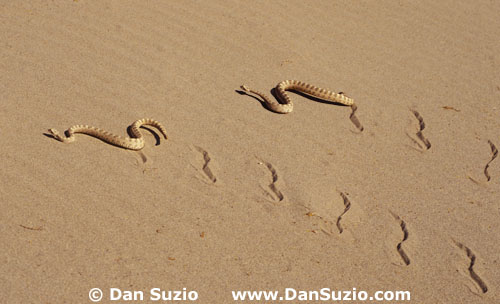
On the way back to my car I saw the tracks of a sidewinder crossing on top of the human footprints. That made it even better.

 Part 2: I finally make it to the celebration.

Tuesday, June 5, 2012

Shooting the breeze


Like all photographers, I love sand dunes. Their subtle shadings and sensuous curves make them a classic subject in nature photography. I'm especially intrigued by their endless patterns within patterns, revealing new and surprising compositions on every scale, from wide-angle to macro.

Like all camera owners, I hate sand dunes. Their two basic ingredients – sand and wind – are a deadly combination for photographic equipment. Desert sand can be extremely fine, and can penetrate even the most tightly sealed lens.

Maybe that explains why the overwhelming majority of sand dune photos depict peaceful scenes of a serene and silent desert. Those scenes are beautiful, I agree, but do they really show what a sand dune is? Is it even possible to make a photo that shows the beauty and serenity of the dunes and the dynamic, often violent winds that create them? How do you photograph wind, anyway?

Late one afternoon last spring, I headed out onto the dunes in Saline Valley, hoping once again to capture that beauty and movement in a single photo. I started my walk in a light breeze, but within ten minutes it felt like a hurricane. The wind was like sandpaper on my face. I could barely open my eyes to see where I was going, and at times I had trouble keeping my balance. Photography seemed out of the question, but I really wanted the shot. I allowed myself a half hour and then headed back to the car, where I spent the rest of the evening cleaning my camera.